
Senator John Cornyn, founder and Republican co-chair of the Senate India Caucus, strongly defends his vote against a resolution to block sale of American-made F-16s to Pakistan.

Members of his team and industry were right now in India, US Defence Secretary Ash Carter disclosed, 'looking at the potential co-production of fighter aircraft.'
Says CISCO executive chairman John Chambers, who's 'met every leader in the world, and got to know them very well.'

'Modi's initial forays into foreign policy had the flavour of Aswamedha Yagas launched by ancient kings to conquer the world.' 'He overcame the hesitations of history and explored unconventional ways to win friends and influence people.' A fascinating excerpt from Ambassador T P Sreenivasan's new book, Modiplomacy -- Through a Shakespearean Prism.

When Obama signs the NDAA 2017 into law this week, the US-India partnership will be enshrined in US legislation, binding every succeeding administration, whatever its inclinations, to treat India as a 'major defence partner,' says Ajai Shukla.

US trade body says, India's business climate is improving due to economic reforms.
.jpg)
Expressing concern over the investment and innovation environment in India, a top US trade official has said the recent set of economic reforms initiated by the country were not enough to return to the path of robust growth.

To combat terror financing, India and the US committed to work together to check illicit money transfers.
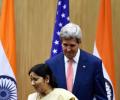
There was no breakthrough in US Secretary of State John F Kerry's India visit, but no breakdown either, says C Uday Bhaskar.
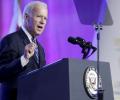
While inaugurating the leadership summit of the US-India Business Council in Washington, DC, US Vice President Joe Biden said that there was no reason why the two largest democracies in the world should not continue to have a more productive relationship. Aziz Haniffa/ Rediff.com reports.

Lobby group tells USTR it has got assurance from India on compulsory licensing.

'Progress demands regular senior-level attention from American leaders.' 'A leaders' summit is great, but we need sustained engagement to continue to forge new agreements and find new areas of cooperation.'

China's official media on Tuesday went public over India's Nuclear Suppliers Group bid for the first time, saying New Delhi's membership of the elite club will not only touch a "raw nerve" in Pakistan and increase a nuclear arms race in the region but also "jeopardise" China's national interests.

The target of $500 billion in bilateral trade by 2020 is doable, feels Anand Sharma.

Trade and economic issues, including visa, totalisation pact and impediments hampering investments, are likely to figure at Monday's US-India CEO Forum meeting, which will be jointly addressed by visiting US President Barack Obama and Prime Minister Narendra Modi.
How far investors will be convinced by Modi's promise to replace red tape with a "red carpet" remains to be seen.

A top Pentagon official will be heading to India next week to hold intense negotiations with Indian officials on critical defence issues and related areas of collaboration that could be announced during US President Barack Obama's visit to the country for Republic Day.
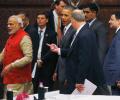
PM promised a tax regime that is predictable and competitive

In a late night statement, the White House said completion of these sales would increase bilateral defence trade to nearly USD 19 billion, supporting thousands of US jobs.

'In the past the US has been reluctant to name Pakistan directly in an US-India joint statement.'

'... For the India-US relationship to continue its positive trajectory, it will require India to adapt to a different approach.' Nisha Desai Biswal -- who as the Obama administration's point person for South Asia was in the inner circle of all the Obama-Modi Summits -- tells Rediff.com's Monali Sarkar why she is hopeful that India and the US are on an irreversible forward course.

Prime Minister Narendra Modi and United States President Barack Obama wrote a joint editorial in The Washington Post, which appeared on its website.

India and the United States are working on efforts to improve cooperation on UN terrorist designations and expand the sharing of information on known or suspected terrorists "no matter where they may be located," says US Ambassador to India Richard Verma

'We use the word "historic" perhaps too much, but the prime minister's visit certainly was historic in so many ways.'

'The US wants Modi to succeed because we want India to succeed. For our part, when India thinks of its partners in the world, we want it to think of the US first. That means positioning our country as the preferred provider of the key inputs that can help to propel India's rise.' 'The meeting between Modi and Obama is, and must be, an opportunity for true strategic dialogue -- not a scripted exchange of talking points, but an open discussion of the big questions. What kind of world do we want to live in? What are our true priorities? And most importantly, why does this partnership still matter?'

There's still little indication of forward movement in Indo-US defence relations.

This is the joint statement issued by the ministry of external affairs on the visit of US President Barack Obama to India.

Lawmakers were not going to be in town on that particular day, and would be in their constituencies preparing for the mid-term elections in November. Rediff.com's Aziz Haniffa reports
US Assistant Secretary of State for South and Central Asia Nisha Desai Biswal believes the India-US nuclear deal is not in limbo and it is for India and Pakistan to set the pace for conversations to resolve their issues. Rediff.com's Aziz Haniffa reports from Washington, DC.

'It is in the interest of both sides that the visit of the US President is seen as being successful. Both sides have invested considerable political capital in it. This rapid exchange of visits and the decisions taken have to be justified, beyond the symbolism, which is no doubt important in itself. This opportunity to impart a fresh momentum to ties should not be missed,' says former foreign secretary Kanwal Sibal.

'We have a common way of looking at the world, a common way of thinking, and a common set of values that predispose us to be partners. And our interests overlap greatly,' Dr Ashton B Carter, America's next defence secretary, told Aziz Haniffa/Rediff.com in an exclusive interview.

Even a doomsayer like Nouriel Roubini says India is in a sweet spot. If only we'd live up to the promise, says Shekhar Gupta.
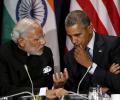
'Big countries do not agree on every set of issues.' 'Look, one of the differences in the relationship is that when we do not agree, we are sitting down and talking to each other.'

'By the time he came out after nearly five hours, he had a one-to-one conversation with the President, a delegation-level meeting, a reception, a dinner, a tour of the White House and a joint statement of a kind none of his predecessors ever had,' says Ambassador T P Sreenivasan.
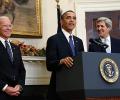
'The threat that India faces and the threat the United States faces is not just to the homeland, but to our people and to our institutions wherever they may be.' In an exclusive conversation with Aziz Haniffa/Rediff.com, US Assistant Secretary of State Nisha Desai Biswal outlines the importance of Prime Minister Modi's visit for America.

As Prime Minister Narendra Modi reached the White House for the private dinner hosted by President Barack Obama, India and the US on Monday issued a vision statement "Chalein Saath Saath: Forward Together We Go" that called for a joint endeavour for prosperity and peace.

Recognising the threat posed by outfits like the Al Qaeda, Lashkar-e-Tayiba and the Dawood Ibrahim network, India and the United States have agreed to deepen cooperation in fighting terrorism and asked Pakistan to bring to justice the 2008 Mumbai attack perpetrators.
Coming down heavily on Pakistan, President Pranab Mukherjee has said unless it dismantles the terror infrastructure on its soil, there is no scope for progress in talks between the two countries.

The US wants to split Sino-India ties, says the Chinese media.

Was the Modi-Obama summit the panacea for all that troubles the India-US relationship?
 © 2026 Rediff.com - Advertise with us - Disclaimer - Privacy Policy - Sitemap - Feedback - About us - Terms of use - Grievances